Vetro
New Module Creation
Task management for field-to-office fiber workflows · Product Manager

Dispatch a work order on the web, complete the task on mobile. Open this page on a desktop browser to try it.
This is a prototype to provide a general understanding of the module. It is not an entirely faithful representation of Vetro's actual product.
Project Summary
Vetro FiberMap is a high-growth Series B SaaS startup at the cutting edge of telecom and fiber network management technology. It had a well-loved web platform for managing fiber networks, and had recently introduced a mobile app that was still struggling to attract meaningful revenue.
I was brought in to own the mobile app and its connected modules across the web platform. I led discovery, set the product vision and strategy, and partnered with engineering and other stakeholders to build a new task management module spanning mobile and web from the ground up, and to drive its go-to-market. The result: a more focused, user-friendly mobile experience with strong adoption and revenue growth.
10×
Mobile usage growth
2–3×
Revenue impact from deeper adoption
30×
Faster work review cycle time
The Problem
Mobile had been a real investment, but it wasn’t generating meaningful revenue. Leadership was weighing whether to kill the product or give it away for free, and sales did not want to sell something that was not working.
Data and customer discovery pointed to why. The existing app let field staff edit anything in the network. That flexibility was powerful, but overwhelming: too much information that was not relevant, and no clear sense of what to do next. It worked well for small customers whose field staff were tech-savvy and had high autonomy. Larger organizations, who would drive higher license revenue, needed the opposite: a guided experience that pointed staff to exactly where to go and what to do, with required fields so critical data was not missed and no one had to make a second trip to collect it.
Strategy & Vision
Our ICP for this module was large, tier 2 fiber network operators, the accounts that would drive the most license revenue. Their workflow was straightforward: dispatchers defined the work, field staff carried it out, and the office reviewed the results and applied the changes in the system. We did not want to ask anyone to change that process, only to remove the manual handoffs and operational confusion from it.
The vision I gave the team was simple: offer a flexible, scalable, and simple solution that brings the data you need to the field, and brings back changes, all with the utmost security. That vision shaped the guardrails I set for the build, and pointed us toward two field workflows worth making excellent: splicing and inspections.
We invested in splicing because it was a distinct user group we could win: our web platform was already seen as the best for splicing data accuracy, and it would be very hard for competitors to build a comparable product given their platform capabilities. Inspections was the other use case we could win. It rewarded efficiency over exhaustive detail, exactly where our partners’ click-heavy construction tools struggled. Saving 80% of the clicks in this workflow meant faster work and happier users.
Not competing directly on construction workflows kept our partners happy, and gave us long-term license adoption from maintenance crews, securing our second meaningful user group to drive revenue growth.
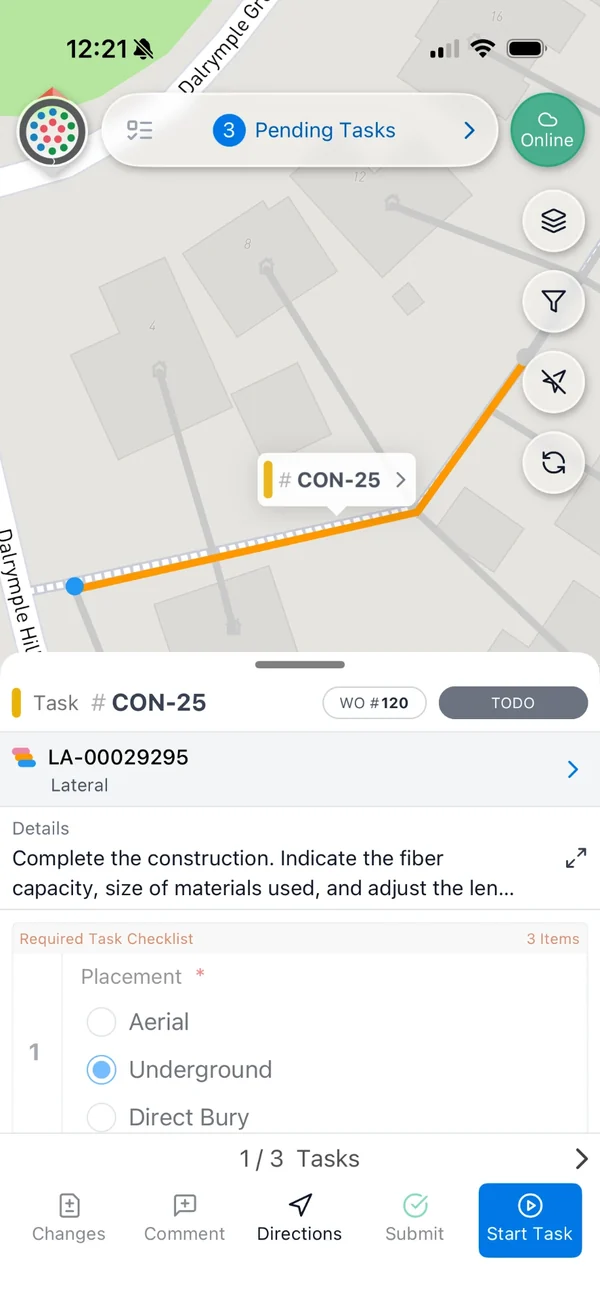
Old versus new mobile field app
Old - Open Ended
New - Focused
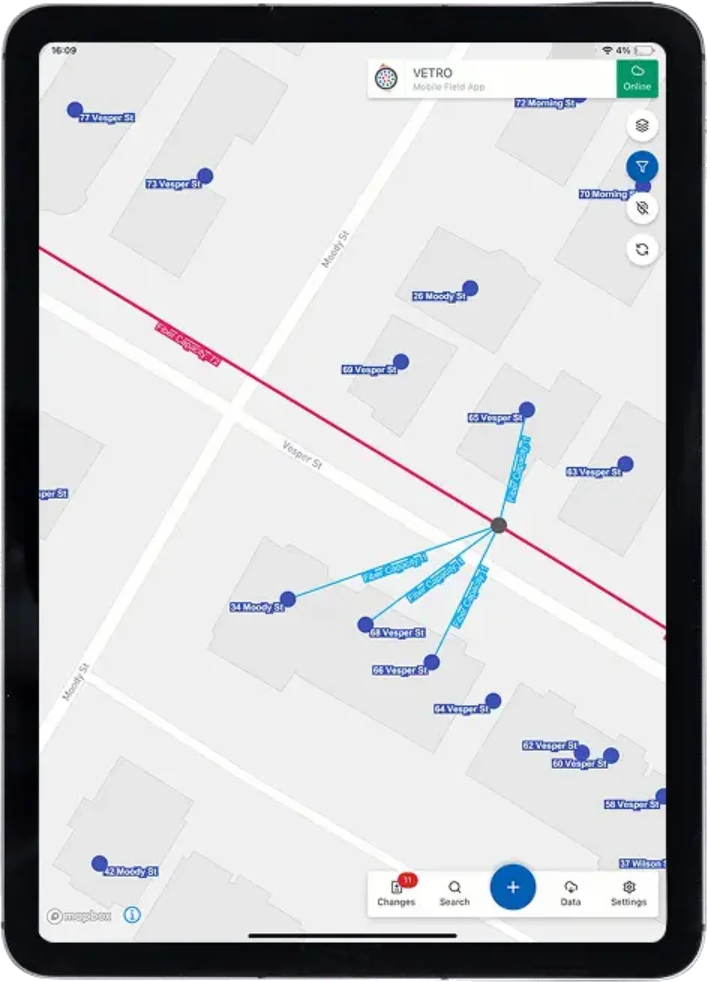
Unclear where
to be
Unclear what to
do next
Indicates where
to be
Clarity on
what to do
Execution & Rollout
With scope and vision set, I worked closely with engineering through the build, dog-fooding the product myself and providing clear feedback. Product demos gave us early validation of the direction, and I ran a beta program with a small group of customers, including one of our largest accounts, to help refine the product and prepare it for market adoption.
What followed was the company’s largest go-to-market motion of the year, and most of it landed on me. A few highlights:
- Adjusted our license roles and pricing to better fit customer needs, driving significant sales on its own
- Led our first sales calls, closing the initial accounts and training solution engineering on the pitch
- Ran customer workshops, defined CS onboarding, and briefed docs and marketing on materials and messaging
- Led webinars and many internal training sessions across sales and CS
Results
Mobile usage grew 10× within the first year after launch, concentrated in our ICP. Our largest customer alone grew from 20 to 150 licenses, and was in talks to add another 150 when I left. Mobile ARR grew 2–3× over the same period, making it a strong revenue driver for the business overall — and the impact on the customer side was even bigger, as the case study below shows.
Beyond the immediate numbers, mobile adoption pulled more of the platform into daily use and drove customers to upgrade their platform licenses. Better field records also changed how customers saw our analytics tool: data they used to ignore became something they valued once it was reliably captured from the field. And the photos and records the app collected laid the groundwork for several AI features built on top of that data.


Get in TouchJK, not Brian’s actual face. :)
“What used to take months now happens in days, and we’re going live with an accurate network every time.”
Brian O., Engineering Manager