DelveIn Analytics
0→1 SaaS Startup Founding
Real estate data SaaS platform · Co-founder, Product & Sales
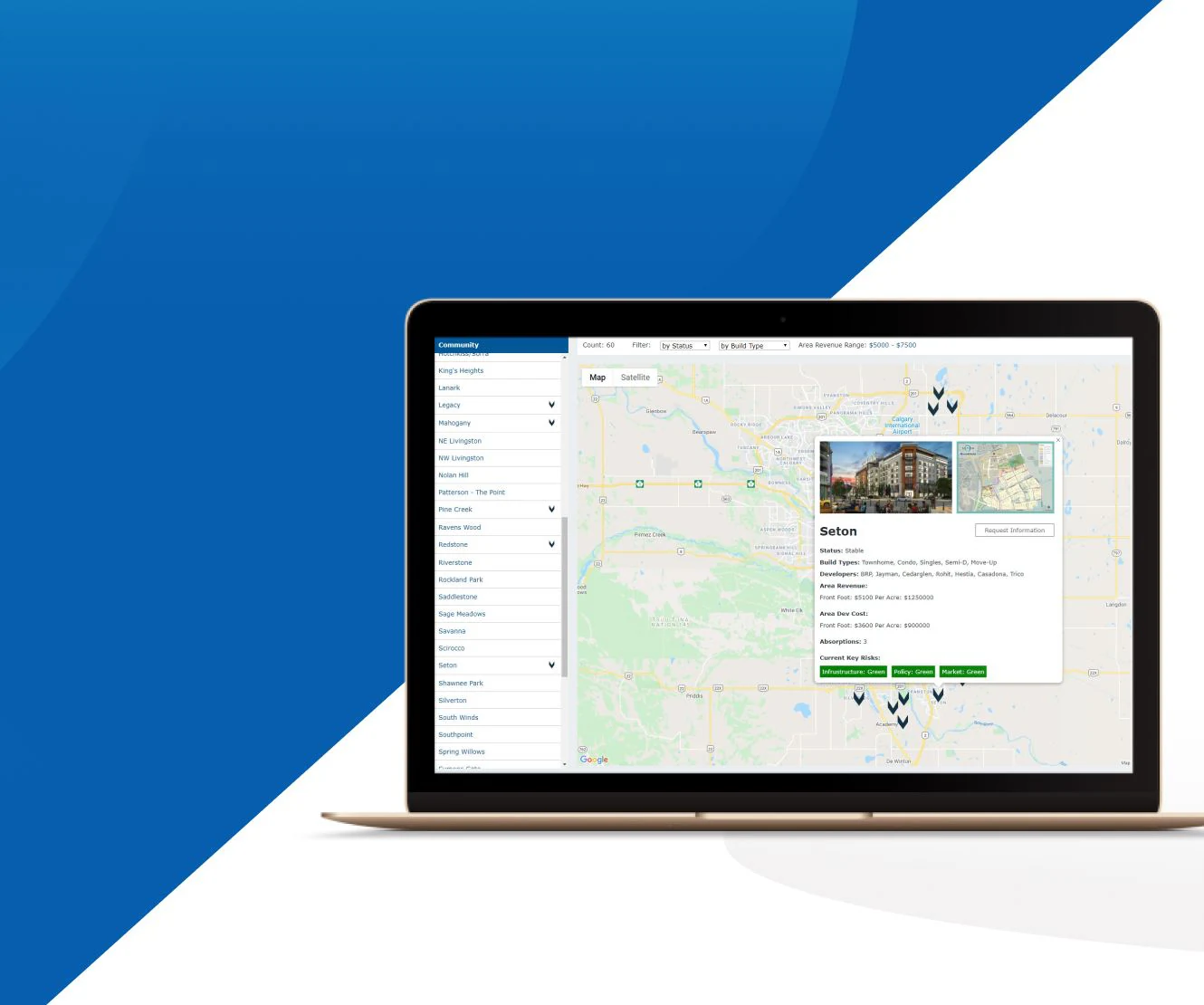
Explore development data for Calgary-area communities on a live map. Open this page on a desktop browser to try it.

Compare Communities
This is a prototype to give a general sense of the product. All community data shown is fictitious.
Project Summary
DelveIn Analytics was a 0→1 SaaS startup I co-founded from scratch to serve real estate lenders, developers, and builders. It combined live public data, expert insight, and ground-truthed data collection into uniquely actionable insights, driving fast and confident investment analysis.
I partnered with experienced industry executives and a software developer, and led product, sales, and customer success. My role spanned from setting the vision and running discovery to demoing, closing, and onboarding our first customers. The result: meaningful early revenue and a product that resonated with the market, even though it was unproven in the space.
0→$45k
First ARR
30×
Faster comparative analysis
The Problem
Real estate lenders, developers, and builders were making multimillion-dollar decisions on stale, mismatched data. The best comparables often came from reports up to three years old, covering communities miles away with different buyer profiles. It was like buying a stock based on a different company’s numbers from two years ago. Nobody had much confidence in it. Only the largest firms could hire their own research teams, and even they lacked the full picture.
The data that mattered most was also sparse and tightly held. Key figures, like how many homes the market was actually absorbing, weren’t publicly available, and no single player had a complete view. As a result, many of the industry’s biggest investments came down to gut feel and the intuition of experienced leaders.
From 0 to 1
The idea came from our consulting work. Clients kept asking for the same kind of analysis, so my co-founder dug deeper and pinned down the exact data points that would turn a lender’s head.
There was already proof the market would pay. Another tool charged thousands of dollars a month for similar data, but only for multi-family buildings, where a few calls to building operators could fill the gaps. We went after detached homes instead. That data was harder to get, which made it more defensible. The plan was to prove the model in one city, then add data like demographics, expand to new cities, and eventually move into multi-family as well.
The data point that mattered most was new home absorptions: of the homes being built, how many were actually selling. It tells an investor how quickly they’ll see a return, and nobody had it reliably. The answer turned out to be sitting in the city’s recycling bins. The city had just started publishing recycling bin registrations by address. Builders never sign up for bins. Homeowners do, when they move in. By comparing each week’s registrations to the last, every net new bin became a sold home. That gave us a near real-time absorption count, an order of magnitude better than what even the best-funded research teams had.
The rest of the dataset came together quickly, and we validated that we could collect each piece repeatably.
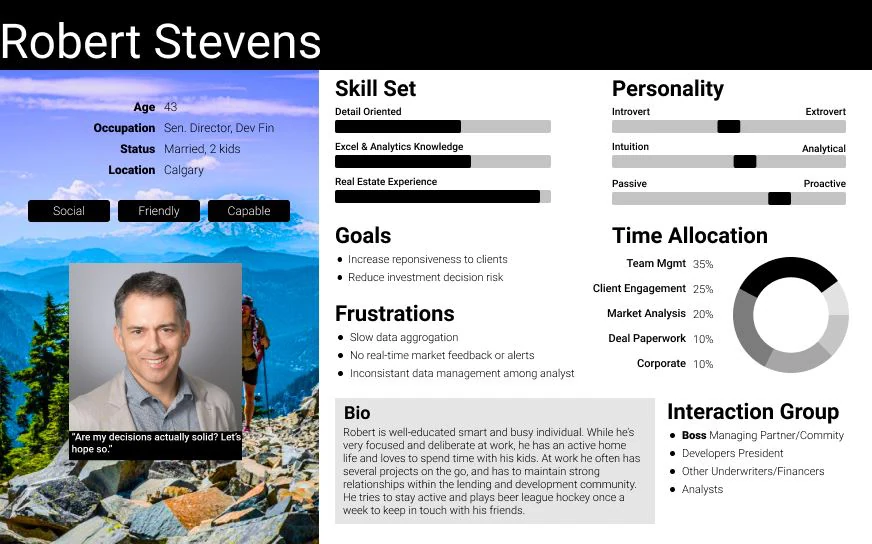
Discovery Artifact: The Lender Persona
Execution & Rollout
Once we had a repeatable process and a dataset the market would buy, we built a quick MVP off my wireframes to get in the door. It put our data on a map with filters, community context, and an absorption visualization for the aha moment. It also had expert opinions on each community and data export.
The first calls didn’t close a sale, but they landed us excellent build partners. Through discovery with them, I learned how their organizations were structured, their investment process, and the two pain points that mattered most: confidence in the investment and speed of execution.
That led to a community comparison table with export, which made investment analysis 30× faster than copying figures from stale reports into spreadsheets. Paired with our data, it closed our first customers.
Results
By the end, we had the best product on the market for data on new-build detached homes. We had datapoints no one else offered, and the comparison table made competitive analysis 30× faster.
I brought in and closed our first three customers, worth $45K in ARR. I also got us into an accelerator program and secured grant funding, which let us hire interns to grow operations.
I stepped away from the business after that. DelveIn went on to expand into Edmonton and add new datapoints.